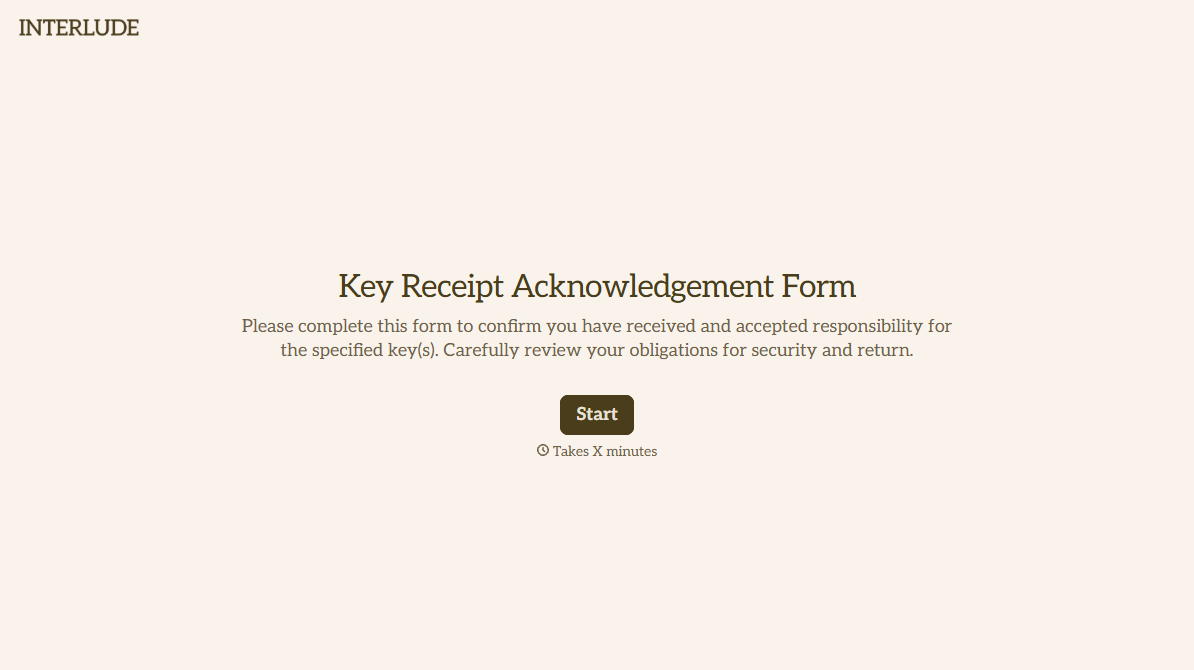
Key Receipt Acknowledgement Form
Record exactly which keys someone received, when, and what they agreed to about returning them. Collect the key numbers, the holder, and the terms in one acknowledgement.


You can switch off a badge or a login from your desk. Once a key leaves your hand, the only way to revoke access is to ask for the key back. Typeform's key receipt acknowledgement form logs the specific keys handed over, the person who received them, and a timestamped record of the date the keys changed hands.
With this form, recipients confirm the keys they're taking, identified by number or stamp, and accept your terms on duplication, replacement cost, and return. Conditional logic reads whether the recipient is a tenant or a member of staff. A tenant sees the move-out terms and what a re-key costs. Staff and contractors see the return date and who to tell if a key goes missing. Both paths record the exact keys that changed hands, rather than just a count of them.
When keys come back, you check them against what keys and how many keys went out, instead of relying on someone's memory. If you find a discrepancy between the keys you handed out and the ones you got back, you can reference this form to take action.
A key receipt acknowledgement form is an online form a person signs when you hand them a key. It records which keys they took, listed one by one, the date they got them, what a replacement costs, and their promise not to copy a key or pass it to anyone else. Landlords, property managers, and facilities teams that use one always know who holds which key, and have a signed record to point to if a key goes missing.
Without a key receipt acknowledgement form, you hand the keys over and fill in a line in a spreadsheet or a key receipt, if anyone remembers to fill it in. Months later at move-out, the tenant might say they only got two keys, when you remember giving them three. A key receipt acknowledgement form lists every key the person received and what they agreed to pay if one goes missing, so everything is documented clearly.
Record what the handover has to establish:
- Holder's name and contact
- Each key or fob, identified individually
- Property, unit, or area it opens
- Date issued and expected return
- Replacement cost and duplication terms
Add a question at the top asking whether this is an issue or a return, and let conditional logic show the right follow-ups. On a return, record the date and check off each key by the number listed when it went out. Match the keys against those numbers rather than counting what's on the desk, since three keys on the desk tells you nothing about which three.
Yes. Turn on a respondent email notification and they get their answers the moment they submit: which keys they took, the date, the replacement cost, and the terms they agreed to. Both sides then hold the same record, which is what stops a disagreement before it starts. On a paid Typeform plan you can also add a File Upload question and attach a photo of the key set handed over, so there's no argument later about whether a fob was included.
Get inspired by relevant templates and categories
3200+ Templates, 300+ Integrations
With Typeform, you can customize everything
Change text, colors, and even logos to match the look and feel of your brand. Then embed forms smoothly onto web and email.
Make forms feel effortless to fill out. Pace questions, call people by their name, and adapt the flow based on the data they share.
Stay efficient by connecting forms to your workflow. Typeform integrates with 300+ tools including Slack, Zapier, and HubSpot.