Lecturer Evaluation Form Template
Collect structured student feedback on lecturers so academic leadership has useful data to act on.



End-of-semester feedback is only valuable if it's honest, specific, and actually reaches the people who can act on it. Paper evaluation forms get lost, anonymous feedback boxes go unanswered, and vague ratings like "4 out of 5 for teaching quality" don't tell anyone what needs to change. When the feedback process feels like a formality, students disengage and the data becomes noise.
A Typeform lecturer evaluation form collects structured feedback that's both measurable and specific. Rating scales capture overall sentiment while open-text questions let students explain their scores in their own words. The one-question-at-a-time format encourages more thoughtful responses than a dense grid. Conditional logic can route students to follow-up questions based on ratings, so low scores prompt for more context without adding length to every response.
Distribute it at the end of each teaching period, make it anonymous, and connect responses to your academic review process.
A lecturer evaluation form is a structured feedback survey completed by students at the end of a course or teaching period. It assesses teaching quality, communication, course material, and overall student experience.
Structured evaluations give academic leadership comparable data across lecturers and courses, making it easier to identify trends, address issues, and support professional development. Vague or informal feedback rarely produces actionable insight.
Cover the dimensions that reflect teaching quality:
- Overall rating of the lecturer
- Clarity of explanations and delivery
- Responsiveness to student questions
- Organization and structure of the course material
- Accessibility and approachability outside class
- Whether the course met its stated learning objectives
- Open field for suggestions or additional comments
Frame the evaluation as a direct input into course improvement, not a formality. When students see that feedback from previous cohorts led to specific changes, participation rates and response quality both improve. Consider communicating what changed as a result of past evaluations.
Voluntary evaluations typically produce more genuine responses, but lower completion rates. Mandatory evaluations improve sample size but can produce perfunctory answers. Many institutions require completion as part of course wrap-up while making all responses anonymous to balance both concerns.
Get inspired by relevant templates and categories
3200+ Templates, 300+ Integrations
Travel Feedback Form
A quick "so, how was the trip?" when someone's back in the office doesn't tell your travel team which hotel to stop booking or which flight change actually caused the headache. Collect what your team actually needs, trip details, what worked, and what didn't, once the traveler's had a minute to think about it.
View template
Library Feedback Form
A comment card dropped in a suggestion box isn't a channel your staff can act on quickly, especially when nobody can tell if it's about a broken chair or a request for more audiobooks. Collect the specific feedback, which branch and department it concerns, and a way to follow up before the card gets buried under next week's stack.
View template

Travel Agency Feedback Form
A generic satisfaction survey emailed three weeks after a trip isn't the kind of feedback an agency can act on, especially once the specifics of a rough hotel transfer have faded. Collect feedback on the specific parts of a trip while it's still fresh, so a complaint that needs immediate follow-up doesn't sit behind a stack of routine responses.
View template
Medical Teaching Feedback Form
An evaluation handed out on the last day of a rotation, filled out in the hallway before everyone scatters, isn't the kind of feedback that helps a program improve teaching quality. Collect specific, timely feedback on teaching encounters before it fades into a generic "good rotation" comment.
View template
Technician Evaluation Form
A ride-along evaluation scribbled on a clipboard in the truck isn't the kind of record that holds up months later when it's time to talk about a raise or a certification renewal. Collect specific skill, safety, and customer service observations while the job's still fresh, so a technician's review is built on more than a supervisor's memory of the day.
View template
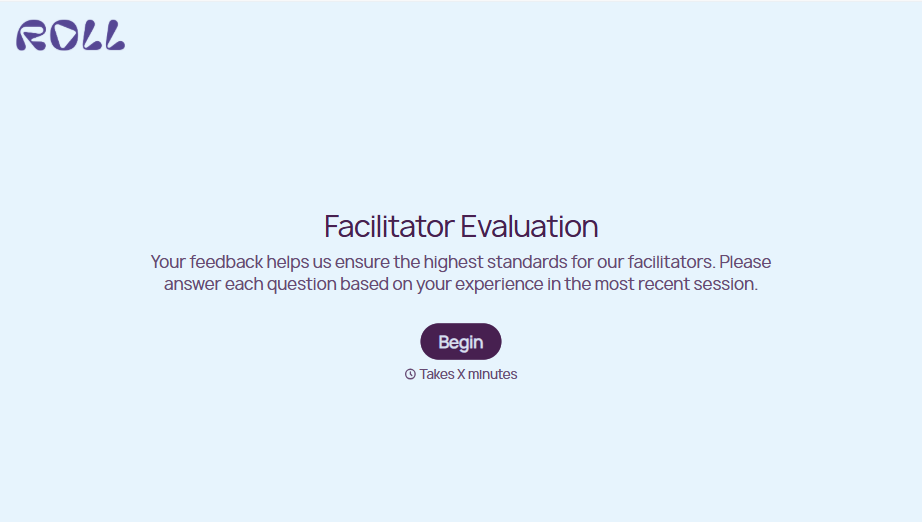
Facilitator Evaluation Form
A round of applause and a few nodding heads doesn't tell your program which facilitator's session actually clicked and which one needs coaching before the next cohort. Collect what your team actually needs, session details, ratings, and specific feedback, before everyone moves on to the next session.
View template
With Typeform, you can customize everything
Change text, colors, and even logos to match the look and feel of your brand. Then embed forms smoothly onto web and email.
Make forms feel effortless to fill out. Pace questions, call people by their name, and adapt the flow based on the data they share.
Stay efficient by connecting forms to your workflow. Typeform integrates with 300+ tools including Slack, Zapier, and HubSpot.