What businesses can learn from a Professor of Social Interaction
We sat down with Professor Elizabeth Stokoe to talk about fake rapport, “burden,” and always putting your customer’s interests first.<br>

Learn more about Liz and how she can help your business here.
Way back in 2013, legendary business journalist George Anders predicted the number one job skill in 2020: empathy.
He saw that as face-to-face interactions are replaced by digital ones, we’ll increasingly crave the authentic feeling of human connection.
And guess what? He was right. From conversational marketing to AI assistants with human voices, companies are doing everything they can to make the digital feel more personal.
But what does it really mean for a business to practice empathy? We spoke with Elizabeth Stokoe, Typeform’s very own Professor of Social Interaction at Loughborough University, to find out how companies can get better results by putting their customers’ interests first.
Listen to the interview above—recorded in a Barcelona cafe—or scroll down for some key takeaways.
Take the burden off your customers
If a conversation is left unresolved for one of the participants, they’re left with burden. This means they’ll have to follow up to get information they feel is missing.
According to Liz, businesses leave their customers with burden all the time. She often helps organizations reduce burden in their interactions. The result? An upswing in positive feedback about the service, and less time spent dealing with queries.
Podcast hosts Paul and Eric found it easy to come up with examples of where burden might appear:
So whether you’re signing off an email, writing a survey, or ending a phone call—make sure your customer is satisfied with the outcome before you finish.
Don’t force small talk
Liz doesn’t think you should always go beyond the transaction when interacting with your customers. We experience this a lot when over-friendly sales people and over-familiar copy lay it on too thick.
Need an example? Check out this juice carton’s attempt to be quirky:
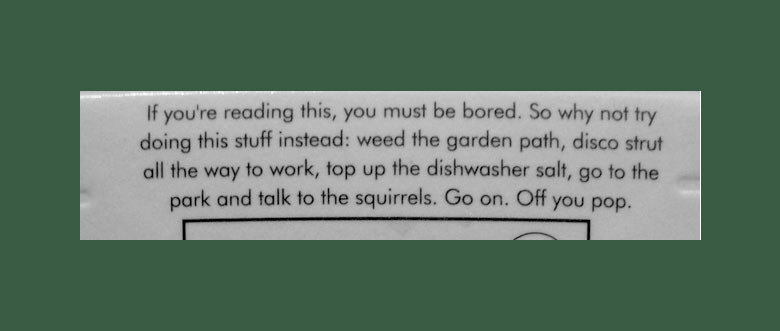
If your customer is interested in chatting about more than business, by all means continue the conversation. But Liz found that straightforward business interactions aren’t just faster—they’re more likely to reach a successful outcome.
Start with ‘what’
Podcast host Paul wasn’t so sure about this one. When working with a mediation service, Liz found that more people signed up when the service was explained in terms of its outcome for the customer, instead of its ethos or purpose.
This appears to go against Simon Sinek’s famous TED Talk, “Start with why.” And Paul’s a pretty big Sinek fan. But him and co-host Eric got to the bottom of it:
It’s fine to be open about company ethos with customers—but the connection between your ethos and the outcome for your customer should be clear.
One word can make all the difference
For many people, the first question they’d ask a Professor of Social Interaction would be something like: “So is there a magic word that’ll make people do whatever I want?”
Well, turns out the answer is yes. Kind of. Liz found that when there’s resistance, asking someone if they’re ‘willing’ to try something is more likely to get a positive response. This magic word makes it harder for people to say no, as they risk sounding unreasonable.
And that’s not the only one-word change that makes a huge difference. Other research reveals the power of switching ‘any’ for ‘some.’
So think hard about how you phrase requests to get the answers you want. Because…
How you ask is everything
Liz’s final takeaway was what conversation analysts call “recipient design.” In face-to-face conversation, we’re always changing how we phrase requests and responses based on who we’re talking to.
You wouldn’t ask your boss for a cup of coffee the same way you’d ask your best friend. And the same should apply to a business interacting with its audience. Treat each customer like an individual, and always ask yourself: am I really entitled to ask this question?
Because keeping your audience at the top of your mind doesn’t just mean smoother interactions—as Liz shows, it also means better results.
No need to wait for 2020. Empathy is already the key business skill.

Liked that? Check these out:
.webp)
.webp)
Opinions and Expertise
The rise of adaptive, momentum-driven journeys (and the fall of the static funnel)
Human behavior isn't a neat funnel—it's a constellation of scattered but connected moments. Adaptive, momentum-driven journeys act on these moments in real time to deliver a customer experience that naturally drives conversions. That's why they're replacing the familiar but dead static funnel.
Más información

Opinions and Expertise
Customer flows, not funnels: Why marketers are rethinking how customers move
Marketing funnels assume customers move in straight lines—but they don't. Customer flows use automated workflows to build momentum, with one action triggering the next. See how Typeform Contacts & Automations helps you meet customers where they are, automatically.
Más información