Zero-party data: a beginner's guide
For years, businesses built their marketing strategies on data collected behind the scenes—tracking pixels, third-party cookies, browsing behavior, and purchase histories stitched together from sources the customer never directly interacted with. That era is ending.

Contents
Browser restrictions, privacy regulations, and shifting consumer expectations have made third-party data increasingly unreliable and legally complicated. The alternative that's gaining ground is zero-party data: information that customers share with you intentionally, proactively, and on their own terms.
If you're a marketer, product manager, or business owner trying to understand your customers without relying on surveillance-style tracking, zero-party data is worth your attention. Here's what it is, why it matters, and how to start collecting it.
What zero-party data actually is
Zero-party data is information a customer deliberately and voluntarily shares with a brand. It includes stated preferences, purchase intentions, personal context, and communication choices—anything the customer actively tells you rather than something you infer from their behavior.
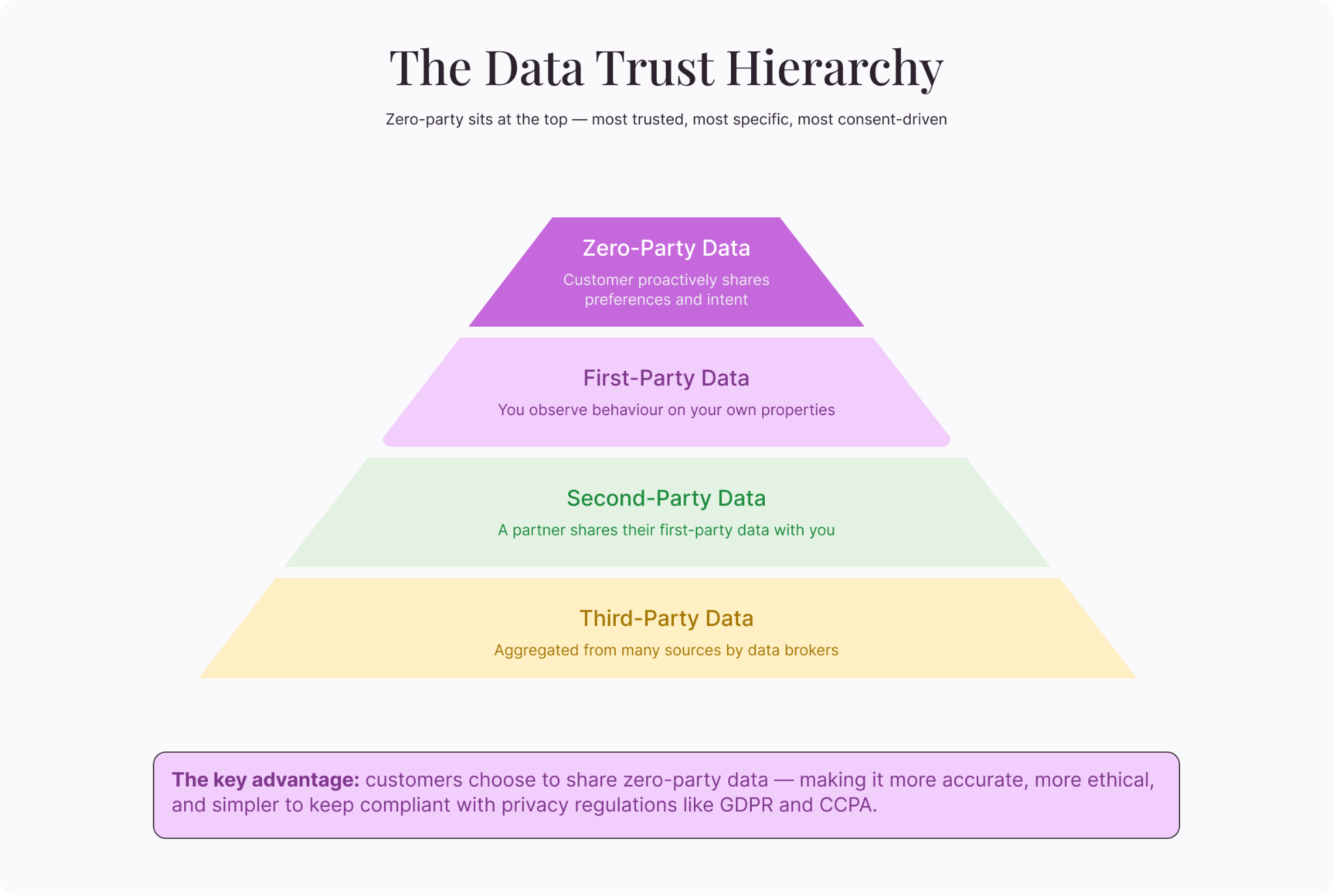
The term was coined by Forrester Research to distinguish this type of data from the more familiar categories. Here's how the four data types compare:
- Zero-party data – The customer proactively tells you their preferences, intentions, and personal context. For instance: "I'm interested in running shoes, size 10, and I prefer email over SMS."
- First-party data – You observe the customer's behavior on your own properties, including website visits, purchase history, app usage, and email opens.
- Second-party data – You get another company's first-party data that they share with you through a partnership or data exchange.
- Third-party data – You get data aggregated from many sources by data brokers, including behavioral profiles, demographic segments, and interest categories built from cross-site tracking.
The critical difference with zero-party data is consent and intent. The customer isn't just passively generating data through their behavior. They're actively choosing to share specific information because they see value in doing so.
Why zero-party data matters now
Several forces are converging to make zero-party data more relevant than ever.
Third-party cookies are disappearing. Safari and Firefox have blocked third-party cookies entirely. The broader industry trend is moving toward privacy-first alternatives. The cross-site behavioral data that powered digital advertising for two decades is becoming less reliable and harder to use.
Privacy regulations keep expanding. GDPR in Europe, CCPA in California, and a growing wave of similar legislation worldwide have raised the legal bar for collecting and using personal data. Consent requirements are stricter, penalties for violations are higher, and consumers are more aware of their rights.
Consumer expectations have shifted. People are more skeptical of invisible tracking and more willing to share data when they understand the exchange. Most consumers say data privacy is a growing concern. Yet the same people willingly share preferences with brands they trust—when they can see the benefit.
Personalization still drives results. Customers still expect relevant, personalized experiences. They just want that personalization to be built on information they chose to share, not information that was extracted without their awareness.
Zero-party data resolves the tension. It enables personalization while respecting privacy, because the customer is an active participant in the exchange rather than a passive subject of observation.
What zero-party data looks like in practice
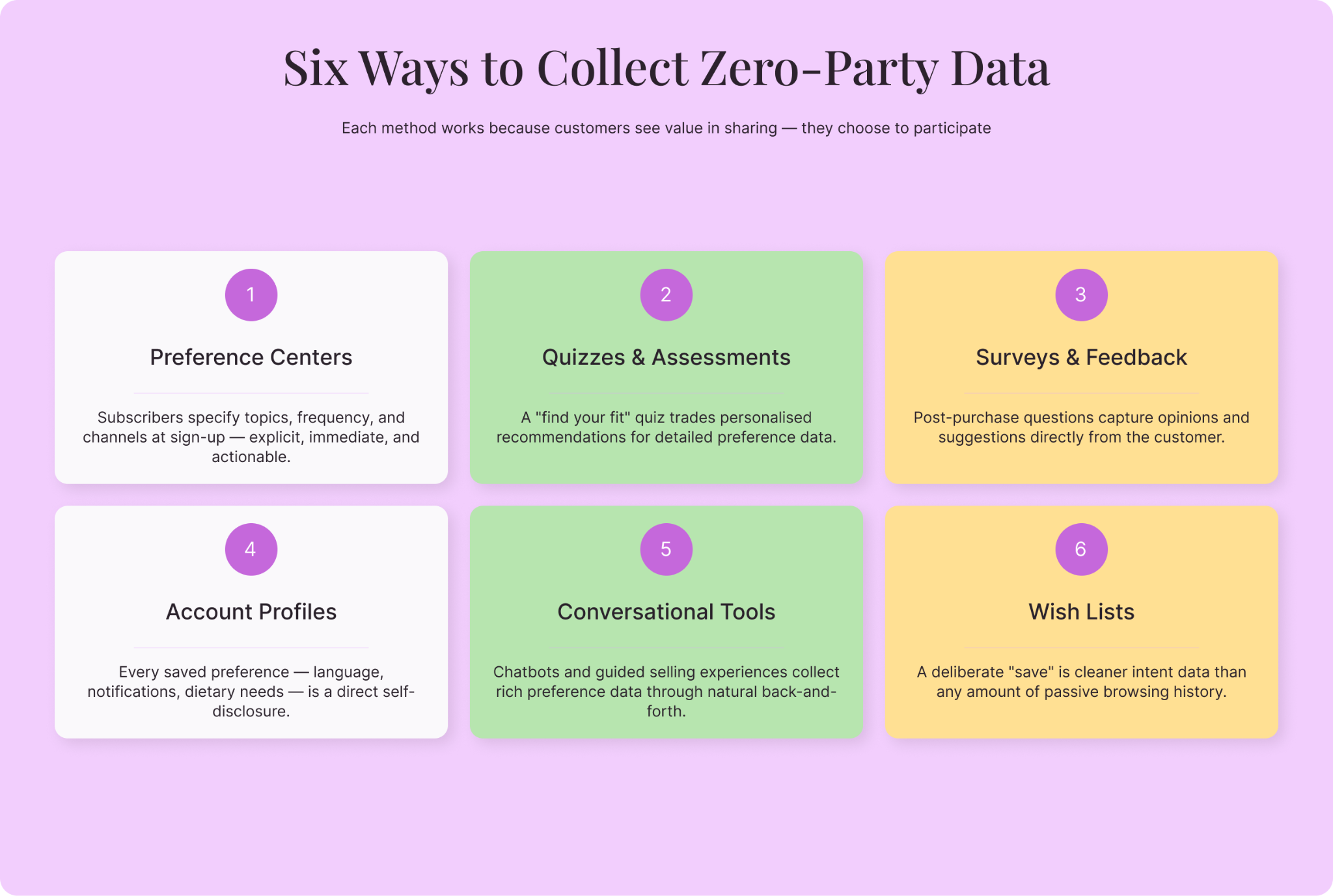
Zero-party data collection happens through direct interactions where customers volunteer information. The most common formats include:
Preference centers. When a customer signs up for your email list, a preference center lets them specify what topics they're interested in, how often they want to hear from you, and through which channels. This is zero-party data—the customer is explicitly telling you how to communicate with them.
Quizzes and assessments. A skincare brand's "find your routine" quiz asks about skin type, concerns, climate, and lifestyle. The customer provides this information willingly because the payoff is a personalized recommendation. The brand gets detailed preference data that no amount of cookie tracking could provide.
Surveys and feedback forms. Post-purchase surveys, Net Promoter Score (NPS) questions, and feedback forms collect opinions, satisfaction levels, and suggestions directly from the customer. They're telling you how they feel—not just what they did.
Account profiles and settings. When users set preferences in their account (notification settings, language, display preferences, dietary restrictions on a food delivery app), they're sharing zero-party data about how they want to interact with your product.
Conversational interactions. Chatbots, interactive forms, and guided selling experiences that ask questions and adapt based on answers collect rich preference data through a natural, exchange-based format.
Wish lists and save-for-later features. When a customer adds items to a wish list, they're explicitly signaling intent and preference. This is more reliable than inferring interest from browsing behavior, because the customer took a deliberate action.
How to collect zero-party data effectively
The mechanics of zero-party data collection are straightforward. The harder part is creating an exchange that customers want to participate in.
Lead with value
Nobody fills out a quiz or a preference form out of obligation. They do it because they expect something useful in return—a personalized recommendation, a better experience, relevant content, or simply feeling understood.
So, make your value proposition explicit. "Tell us what you're interested in so we only send you relevant updates" is more compelling than "Complete your profile." Frame every data request as an exchange: the customer gives information, and you give a better experience.
Keep it lightweight
Asking for too much information at once triggers survey fatigue and privacy concern. A five-question quiz gets completed. A 30-field form gets abandoned.
Collect zero-party data gradually. Ask for a few preferences during signup. Offer a quiz a week later. Add a single feedback question after a purchase. Over time, you build a rich profile without any single interaction feeling burdensome.
Be transparent about how the data will be used
Trust is the currency of zero-party data. If customers suspect their information will be sold, shared, or used in ways they didn't expect, they'll stop sharing.
State clearly what the data is for: "We use your answers to recommend products you'll actually like." Don't bury this in a privacy policy nobody reads. Put it right next to the data request, in plain language.
Make it engaging
The format of your data collection influences the quality and volume of responses. Interactive quizzes, conversational forms, and visually appealing preference selectors feel more like an experience and less like a transaction. When data collection is enjoyable, more people participate, and they share more honestly.
Respect the opt-out
Participation must always be optional. Making data collection mandatory—gating essential features behind preference forms or requiring quiz completion to proceed—undermines the voluntary nature that makes zero-party data valuable in the first place.
How to use zero-party data once you have it
Collecting data without acting on it is worse than not collecting it at all, because you've spent your customers' trust currency and delivered nothing in return.
With that in mind, here’s how to use your zero-party data effectively:
Personalize communications. Use stated preferences to tailor email content, product recommendations, and notification frequency. A customer who told you they're interested in running gear should see running content—not a generic blast.
Improve product recommendations. Quiz and preference data feeds directly into recommendation engines. The advantage over behavioral inference is accuracy: the customer told you what they want, so the recommendations feel helpful rather than creepy.
Segment your audience. Zero-party data creates segments based on intent and preference rather than demographics alone. "Customers planning a wedding in the next six months" is a more actionable segment than "women aged 25-34."
Inform product development. Aggregated preference data reveals what customers value most, what they wish existed, and where current offerings fall short. This is direct market research embedded in the customer experience.
Close the feedback loop. When a customer's feedback leads to a change, tell them. "You asked for weekly emails instead of daily—done" or "Based on your quiz results, here's a new product that fits your profile." These moments reinforce the value exchange and encourage future sharing.
The limits of zero-party data
Zero-party data isn't a complete replacement for other data types. It has real limitations worth acknowledging:
- Scale is smaller. Not every customer will participate. You'll always have zero-party data from a subset, not the full base.
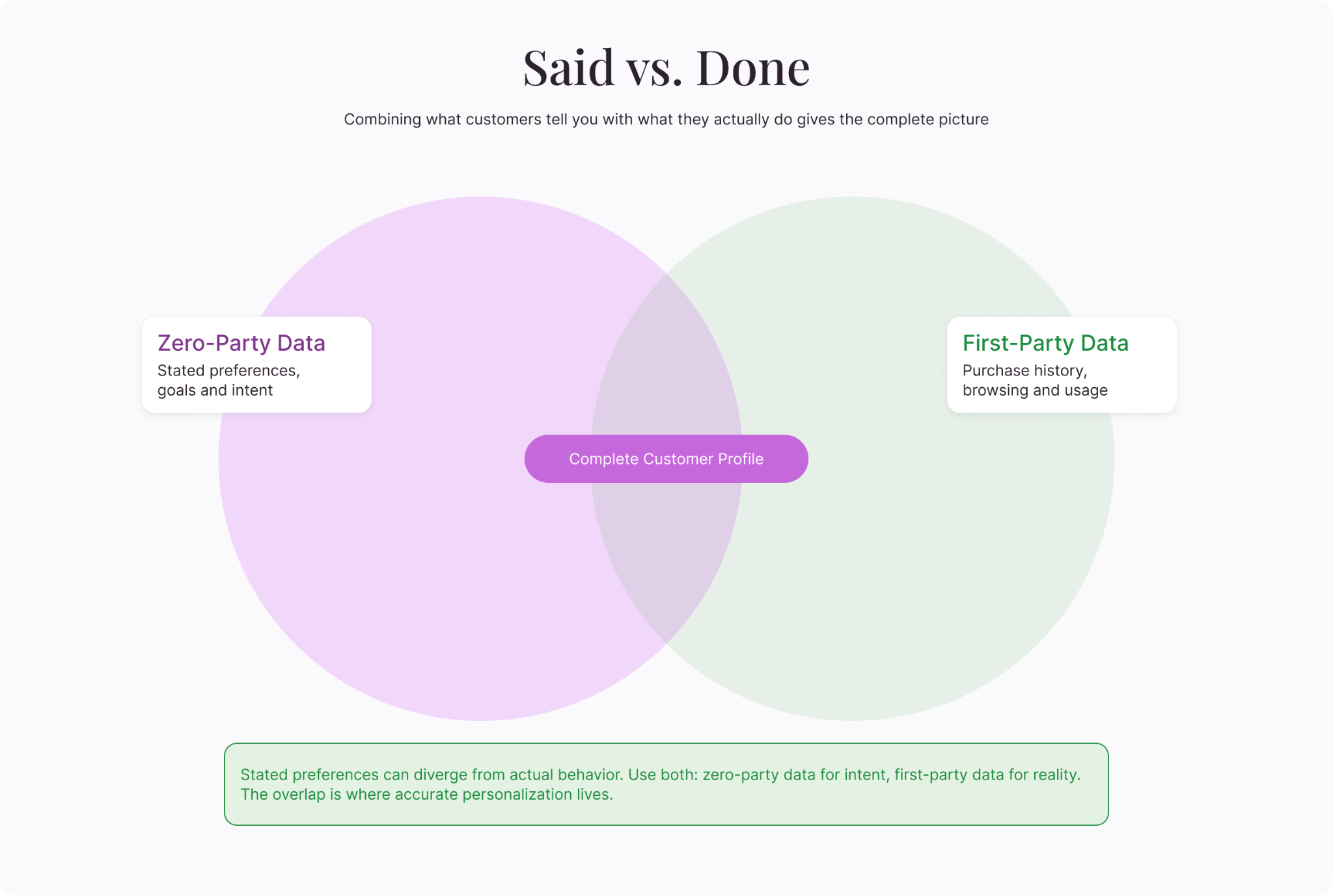
- Stated preferences can differ from actual behavior. People say they want healthy food recommendations, then order pizza. Combining zero-party data with first-party behavioral data creates a more accurate picture.
- It requires ongoing effort. Unlike passive first-party data that accumulates automatically, zero-party data requires active collection moments—quizzes, surveys, preference centers—that need to be designed, maintained, and refreshed.
Data freshness matters. Preferences change. A customer who said they were interested in beginner content six months ago might be advanced now. Build mechanisms to update preferences over time.
Zero-party data vs. first-party data: working together
The strongest customer understanding comes from combining zero-party and first-party data. Each type fills gaps the other can't reach.
Zero-party data tells you what customers say they want. First-party data tells you what they actually do. A customer might tell you through a quiz that they're interested in premium features, but their first-party usage data shows they've never used any advanced functionality. That discrepancy is valuable—it might mean the onboarding for advanced features needs improvement, or it might mean the customer's aspirational self-image doesn't match their actual needs.
The combination also strengthens personalization. A recommendation engine powered only by behavioral data might suggest products based on past purchases—which works until a customer's needs change. Adding zero-party data ("I'm training for a marathon" or "I'm redecorating my living room") lets you anticipate what they'll want next, not just reflect what they've already bought.
Organizationally, this means breaking down the wall between your survey/quiz data and your analytics platform. When preference data and behavioral data live in the same system—or at least talk to each other—you can build customer profiles that are both stated and observed, which is far more useful than either alone.
Privacy regulations and zero-party data
Zero-party data simplifies compliance with privacy regulations, but it doesn't eliminate the need for care. Even when customers volunteer information, you still have obligations under GDPR, CCPA, and similar frameworks.
This means you need a lawful basis for processing the data. Consent—which zero-party data collection naturally provides—is the most straightforward basis, but you still need to document it. You also need to store the data securely, limit access to it, and honor deletion requests. And you need to use the data only for the purposes you stated when collecting it. If a customer shared their dietary preferences for personalized recipes, using that data to target health insurance ads violates the implicit agreement.
The good news is that the transparency built into zero-party data collection aligns naturally with regulatory requirements. When you tell customers exactly why you're asking and how you'll use their answers, you're simultaneously building trust and meeting your compliance obligations.
Starting small
You don't need a sophisticated data infrastructure to begin collecting zero-party data. Start with one collection point—a preference center on your email signup, a short quiz on your website, or a single feedback question after purchase. See what customers share, act on it, and build from there.
The businesses that thrive in a privacy-first landscape won't be the ones with the most data. They'll be the ones with the most trusted data—information customers shared because they wanted to, in exchange for experiences that made it worth their while.