Facebook marketing: a complete strategy guide
Just getting started with Facebook marketing? Read on to see how our own Facebook foray goes as we take you through the basics.
Key Takeaways
- Start with a specific goal, not "get more followers": A measurable target like reaching 10,000 followers by Q3 tells you what to build toward and how to measure success.
- Know your audience before you create anything: Facebook Insights and direct polls reveal who's actually engaging, so targeting and content get sharper the more specific you get.
- Organic reach has declined, so paid ads carry the weight: Test headlines, images, targeting, and calls-to-action with small budgets before scaling what works.
- Facebook drives traffic, but email converts it: Use Facebook to build awareness and capture email addresses, then nurture and sell through channels you actually own.
Facebook remains one of the most powerful platforms for reaching and engaging customers. With nearly three billion monthly active users, the platform offers unmatched reach, but that reach only matters if your strategy is sound.
This guide walks you through the fundamentals of Facebook marketing: setting clear goals, understanding your audience, creating resonant content, running effective ads, and measuring results. Whether you're starting out or refining an existing approach, these principles will help you build a strategy that drives real business results.
Why Facebook marketing matters
Facebook's reach is undeniable, but reach alone doesn't generate revenue. What matters is reaching the right people with the right message at the right time.
People share their interests, behaviors, and preferences on Facebook, letting you target audiences with precision that older marketing channels can't match. Trust plays a role too. 80% of people trust brands they already use, and trust in brands has risen to 68% since 2022. When you show up consistently on Facebook, where your audience spends time, you build familiarity and trust.
Step 1: Define your Facebook marketing goals
Before you create a single post or run a single ad, get clear on what you want Facebook to do for you.
Common goals include:
- Building awareness – reaching new people and making them familiar with your brand
- Driving traffic – sending people to your website or landing pages
- Generating leads – collecting contact information from interested prospects
- Increasing sales – getting people to buy your products or services
- Building community – fostering engagement and loyalty among existing customers
Most businesses pursue multiple goals at once, but rank them. What's your primary objective? Write it down in specific terms. "Get more followers" is vague. "Reach 10,000 followers by end of Q3" is actionable.
Step 2: Know your audience
You can't create content or run ads that resonate if you don't understand who you're talking to.
Start by identifying your ideal customer. What's their age range, location, job title, or industry? What problems do they face? If you already have customers, analyze what your best customers have in common.
Facebook Insights shows who's engaging with your content: age ranges, locations, genders, languages, and interests. You can also run surveys or polls directly on Facebook. 82% of users engaged with quizzes shown via their newsfeed.
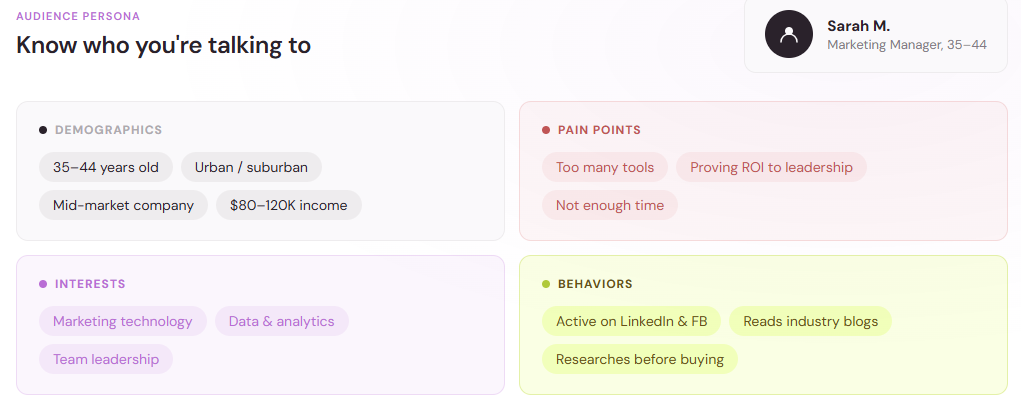
The more specific your understanding of your audience, the more targeted and effective your Facebook marketing becomes.
Step 3: Create content that people actually want to see
The core of Facebook marketing is content. Posts, images, videos, and stories compete for attention in a crowded feed.
Educational content teaches your audience something useful. How-to posts and tips that help them solve real problems perform well.
Visual content stops the scroll. Photos and videos need to be clear and relevant.
Storytelling shares stories about your customers, team, or brand. People connect with people, not products.
Interactive content like polls and quizzes invites participation and increases engagement.
User-generated content shares posts, photos, or testimonials from customers. It's authentic proof that real people value what you do.
Post consistently and align timing with when your audience is most active. B2B content marketing generates an average of $3 for every $1 invested. Companies publishing 16 or more blog posts per month see 4.5 times more leads.
Step 4: Run Facebook ads strategically
Organic reach on Facebook has declined. Paid ads are essential to reach a broad audience.
Image ads use a single photo with a headline and text for building awareness.
Video ads capture more attention than static images and work well for storytelling or product demos.
Carousel ads feature multiple images or videos that people swipe through, useful for showcasing product variety.
Collection ads feature a product or category with related items, designed to drive shopping.
Lead form ads capture information without sending people off Facebook.
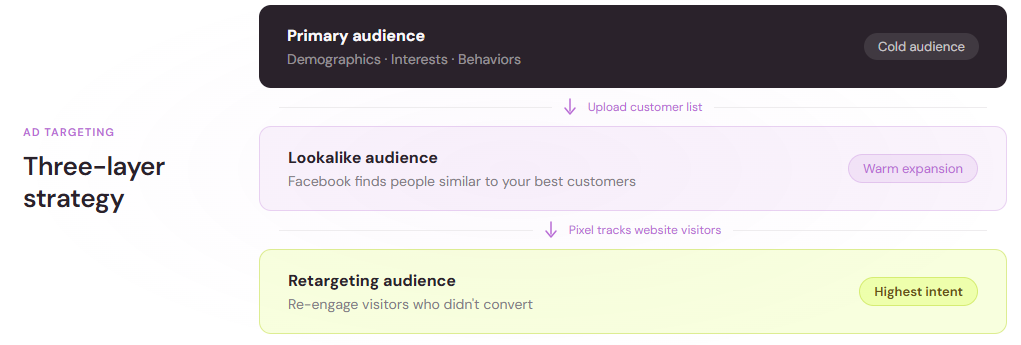
Start with image or video ads. Facebook's targeting is granular: you can target by demographics, interests, behaviors, lookalike audiences, and retargeting.
The best Facebook marketers test constantly. Small changes often yield big results:
- Different headlines or copy
- Different images or videos
- Different targeting parameters
- Different calls-to-action
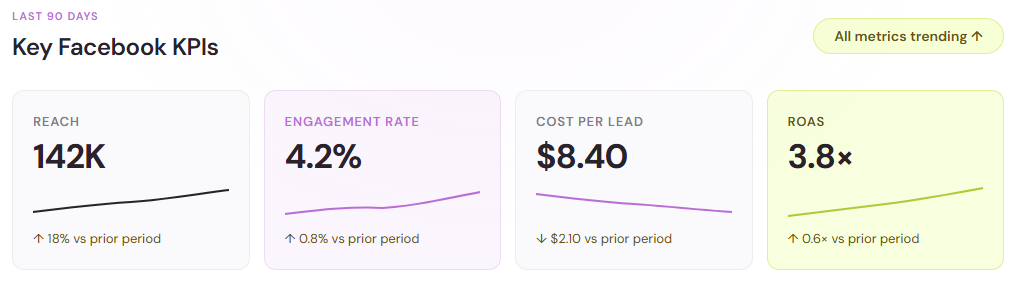
Run tests with small budgets first. If something works, increase the budget. Track metrics that matter to your goal: reach and impressions for awareness, cost per lead for leads, or return on ad spend (ROAS) for sales.
Step 5: Integrate email and owned channels
Facebook reaches people where they spend time, but you don't own the platform. Use Facebook to drive people to owned channels like email.
Email marketing generates the highest ROI among digital channels. Average email conversion rates across industries near 12%. In B2B tech, conversion rates average about 2%.
Use Facebook to build awareness and traffic. Capture email addresses through landing pages. Use email to nurture relationships and drive sales. This simple funnel works: Facebook ad drives traffic → landing page offers something valuable in exchange for an email → weekly newsletter keeps your audience engaged → periodic sales emails convert prospects into customers.
Step 6: Measure what matters
Focus on metrics tied to your goals:
- Awareness goal? Track reach and impressions.
- Traffic goal? Track clicks to your website and bounce rate.
- Lead goal? Track cost per lead and lead quality.
- Sales goal? Track conversion rate and return on ad spend (ROAS).
- Engagement goal? Track engagement rate and conversion.
Connect Facebook to your website using the Facebook pixel so you can track what happens after people click your ad. Set benchmarks for success before you launch.
Step 7: Refine based on data
Every month, review your data. Which content got the most engagement? Which audience segments converted best? Which time of day generated the best results? Which ad format outperformed others?
About 70% of companies report at least moderate adoption of AI across their go-to-market workflows. AI-powered tools can help you spot patterns faster and automate routine tasks.
Bringing it together
Facebook marketing works best when it's part of a larger strategy. Facebook drives awareness and traffic. Email converts that traffic. Your website or product delivers the value.
Start with a clear goal. Get to know your audience. Create content worth their attention. Run ads strategically. Measure what matters. Learn and adjust. Repeat.
This approach will help you build a sustainable Facebook marketing practice that drives real results.

Liked that? Check these out:
Opinions and Expertise
What’s actually slowing research teams down (Hint: it’s not the research)
From recruiting participants and scheduling interviews to building the actual surveys, the operational drag is taking researchers away from what they do best. See what's actually slowing them down and how Research Flow fixes it.
Read more