Do product teams have the support to ship and iterate successfully? What our analysis told us.

It’s an understatement to say research is an integral part of the product development lifecycle at Typeform. As a senior member of the Product team, I find myself partnering with Typeform’s dedicated research staff and using our own Research Flow product in equal parts, all in service of garnering valuable user feedback that helps us make better decisions. Despite the clear value this structure provides for our team, I’ve often wondered whether our investment in continuous research makes us the exception vs. the rule.
To find out, we recently conducted an unmoderated study of 58 professionals spanning seniority and company sizes. The goal was to get a snapshot of the current state of and sentiment around product support, including the role of research, the ways decisions are validated along the product development lifecycle, and how it all affects the speed at which—and confidence in—what is ultimately being shipped by teams.
Here are three themes that emerged from our analysis:
1. Research is alive and well, albeit spread across teams
Our respondents reported they are leveraging research in their product development processes, with the largest count (n=26) reporting that they (i.e., product/design teams) were doing their own research.
The second largest group (n=19) reported that they are leveraging a central research team, while a handful said they had an embedded researcher on their team (n=8).

A common thread among respondents was that the value of research was alive and well, reporting a common dynamic: most features underperform initially, but improve with customer research. The data suggests an overarching sentiment that without real user signals, features stall or languish as costly tech debt.
2. Product teams are shipping at a healthy clip, buoyed by AI
Survey respondents told us that product/feature launches (phrased as “shipping”) are increasing or about the same, but not slowed down, compared to one year ago at their respective companies.
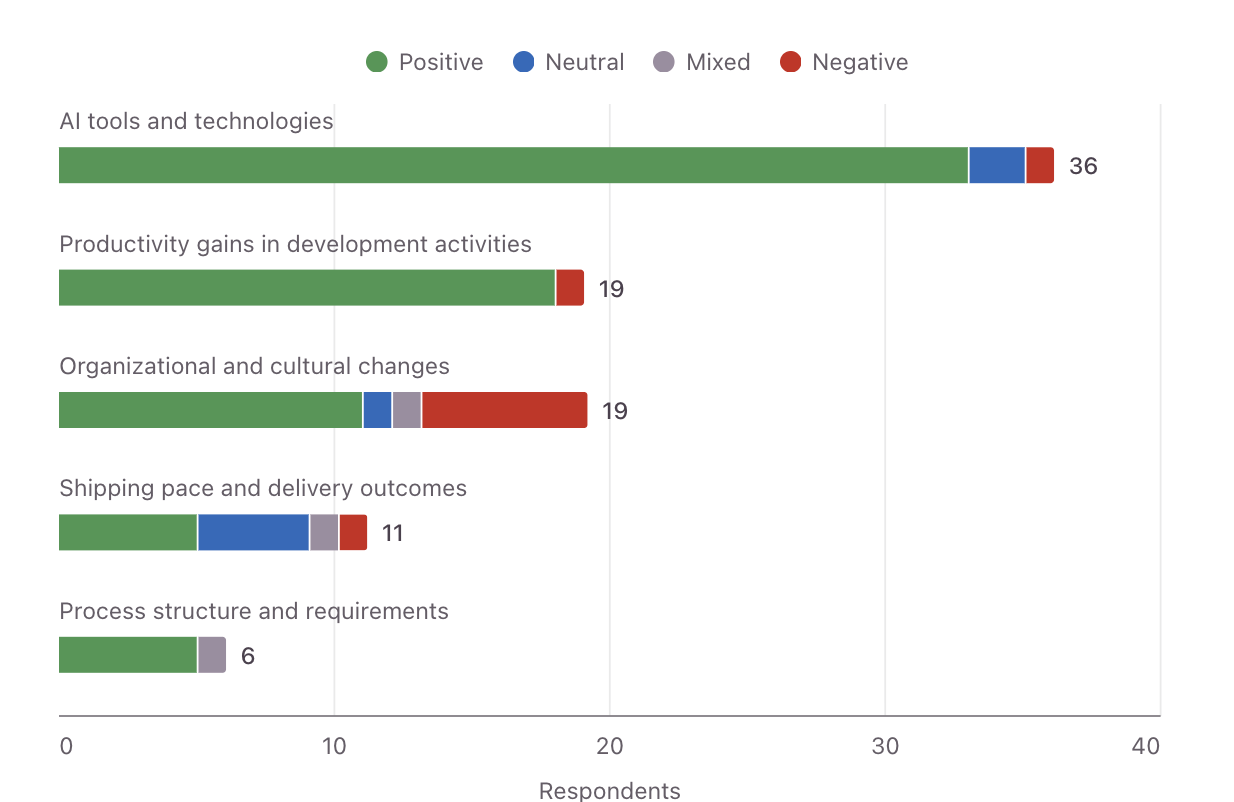
When we followed up on the reasons why, a majority of respondents (n=36) credited AI tools, including prototyping and LLM-powered coding, with accelerating their workflows. Other respondents pointed to productivity gains (potentially buoyed by AI use), along with positive organizational and culture changes, as catalysts for increased outputs.
3. Validation speed comes down to tooling, processes
Even with an increased speed in shipping, validation processes have remained largely the same compared to the prior year, respondents said. When we looked to impact this datapoint further, our analysis found that it ultimately came down to three factors: AI tooling, process shifts, and resource/data bottlenecks.
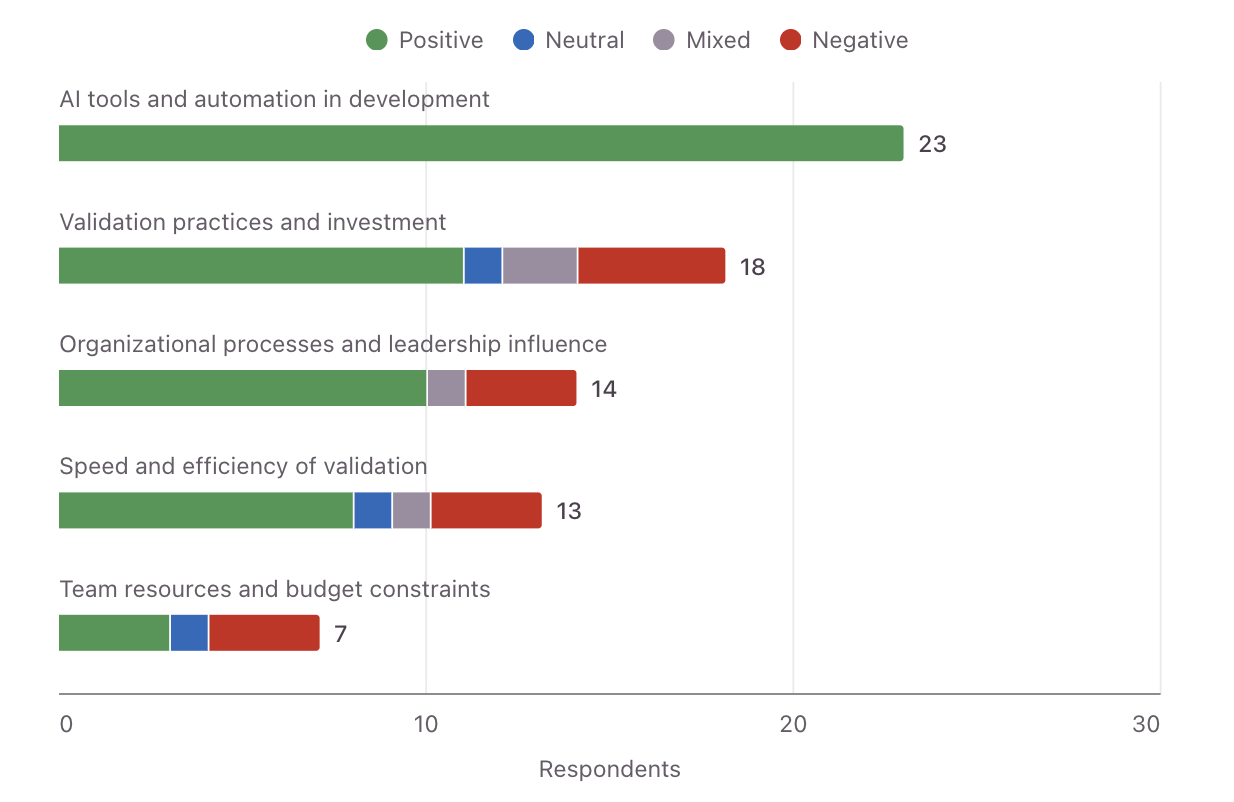
Respondents who mentioned AI tools viewed them favorably: rapid prototyping, automated testing, and AI-assisted coding let teams validate more without proportionally increasing effort.
Leadership changes, better planning frameworks, and deliberate investment in validation processes also earned broad praise from respondents, with one respondent describing validation “becoming more embedded rather than bolted on”, suggesting that tooling gains stick best when paired with structural support.
However, staffing gaps, budget limits, stakeholder scheduling, and inconsistent data access surfaced as recurring friction, capping the momentum that AI tools and better processes have created.
Time, budget, and customer access are constraints on validation
When we dug deeper into the sources of friction in validation, our respondents reported that a triple threat of increasing time pressure, limitations around customer access, and limited budgets from a reinforcing bottleneck that prevents thorough validation.
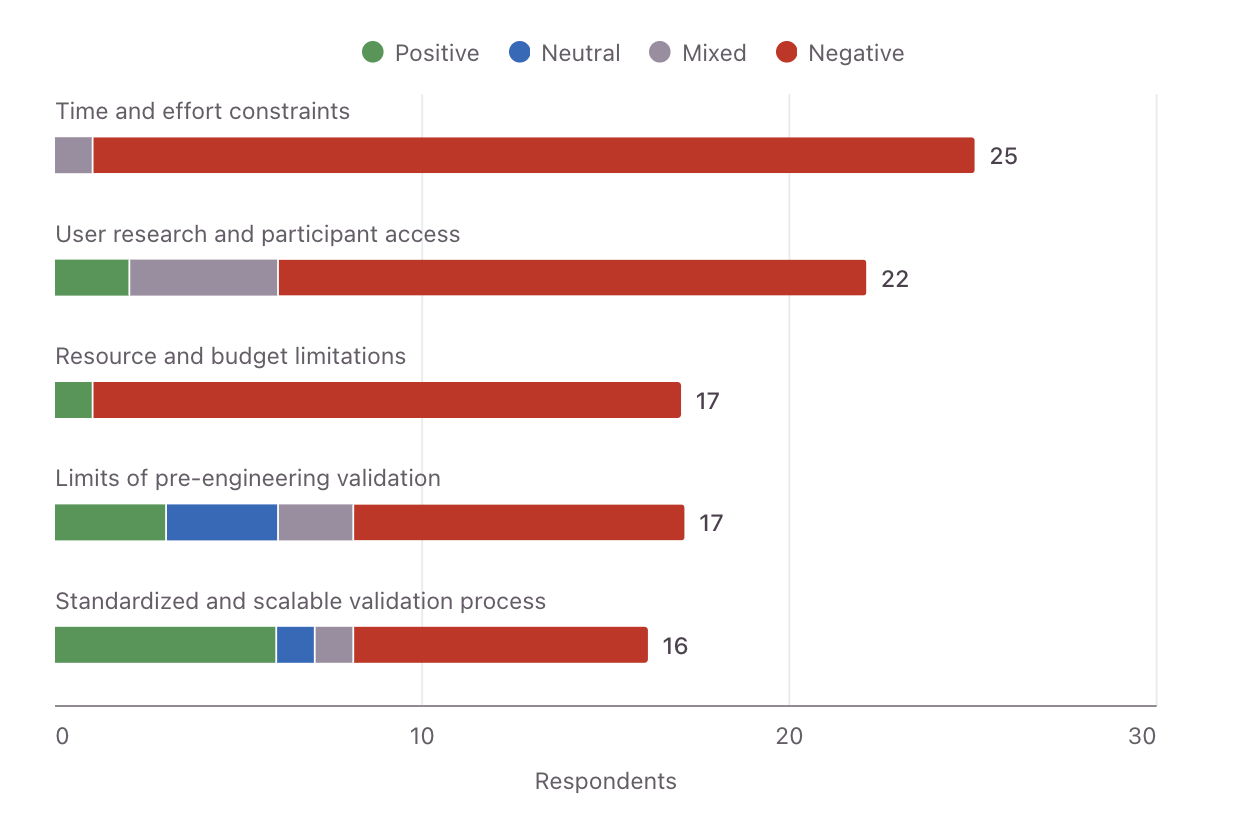
Participant recruitment—and in turn extracting reliable signals from research samples—was cited as a particularly thorny issue for product professionals.
What our analysis tells us
To bring us back to our initial question around product support, our analysis showed that confidence in the products shipped is largely structural (i.e., resourcing and processes), regardless of team or organization size. Let’s recap the three core themes that emerged:
1. AI is speeding up shipping, but validation bottlenecks remain structural
While AI-powered prototyping and code generation are accelerating workflows, time pressure and resourcing constraints still form a reinforcing bottleneck that prevents thorough validation. Organizational friction—headcount gaps, coordination overhead, and leadership churn—further blunts the productivity gains AI unlocks.
2. Research is taking place, but structural efficiency is still an open question
Could an increase in pace come at the expense of structured research? Our data suggests that could be the case—methods like customer interviews and usability testing play supporting roles, while nearly half of teams have no dedicated researcher, relying instead on PMs and designers to handle validation themselves.
3. Feedback loops, resourcing among growing risks to validation
More than half of the respondents pointed to insufficient validation, ignored user signals, or late discovery as headwinds to successful product launches. When features underperformed, respondents reported that they were left to languish, creating lasting tech debt.
The good news is that feedback risk was mitigated by intentional research cadences, including continuous user feedback and A/B testing. Iteration came down to processes and culture—those that iterated on their features after shipping did so because of a focus on continuous, post-launch research.
Methodology
The Typeform team conducted AI-moderated interviews with 58 product professionals during ProductCon on Oct. 6-7, 2026. The study consisted of 10 core questions, with automated follow-ups by our AI moderation tool, Research Flow, to enhance insights through sentiment analysis.
Our sample spanned experience levels, although more than half of respondents (n=30) reported senior, staff, or principal titles. The remainder of the sample was concentrated among mid-to-senior ICs, with leadership roles (e.g., VP, head of product) making up a smaller share.

A majority of respondents (n=19) reported working for companies with greater than 5,000 employees, with the second-highest group (n=12) coming from small-to-mid companies of up to 200 employees.