House Rental Application Form Template
Screen prospective tenants with a structured application process. This template collects employment, income, rental history, and references in one consistent format.



Every landlord has had the experience of collecting applications through email — different formats, missing information, no standard way to compare candidates. You end up making decisions based on incomplete pictures, and follow-up becomes a string of back-and-forth messages to get the basics.
A rental application form standardizes what every prospective tenant provides. Employment details, income verification, rental history, references, and move-in preferences all come through in a consistent format that makes comparison straightforward. Conditional logic can surface additional questions based on employment type — a self-employed applicant needs different income documentation than a salaried employee.
Customize the form for your property's requirements, connect it to your property management system, and build a cleaner tenant screening pipeline.
A house rental application form collects personal, financial, and rental history information from prospective tenants who want to rent a residential property. Landlords and property managers use it to evaluate applicants' ability to pay rent, their rental track record, and their suitability for the tenancy before making a leasing decision.
Comparing applicants without a standardized form is difficult and inconsistent. A structured application gives every applicant the same opportunity to present their background and gives you the same data points on everyone you're considering. It also creates a documented basis for your tenancy decision, which matters if any selection decision is later questioned.
Cover the financial, employment, and rental history details relevant to your screening process:
- What is your full name, current address, and contact information?
- What is your current employer, job title, and gross monthly income?
- How long have you been at your current residence, and why are you moving?
- Do you have any prior evictions or outstanding rent obligations?
- Can you provide 2 references from previous landlords or employers?
- What is your intended move-in date, and how many people will be living in the property?
A common benchmark is that the applicant's gross monthly income should be at least 2.5 to 3 times the monthly rent. Include this requirement clearly in your listing and in the application form itself so that applicants self-screen before submitting. For applicants who don't meet the income threshold, conditional logic can offer the option to provide a co-signer or larger security deposit, depending on your policies.
Ask self-employed applicants to provide recent bank statements, tax returns, or proof of contracts in lieu of a traditional pay stub. Include a file upload field in the application form that's conditional on the respondent indicating they're self-employed. Be consistent in what you require from this group — apply the same standards you'd apply to salaried applicants to avoid any appearance of differential treatment.
Get inspired by relevant templates and categories
3200+ Templates, 300+ Integrations
Musical Audition Form
A name scrawled on a sign-up sheet taped near the rehearsal room doesn't tell a director what role someone's after, or whether they can actually make callbacks next Tuesday. Collect what your production actually needs, contact information, role interest, and availability, before audition day arrives.
View template
Unemployment Insurance Application Form
A stack of pay stubs gathered the morning of a filing deadline isn't the kind of preparation that gets a claim processed without delay. Collect employment history, separation details, and supporting documents before you sit down at your state's unemployment portal, so a claim doesn't stall over a missing detail.
View template
Nationality Verification Form
A self-certification buried in a stack of new account paperwork isn't the kind of record a compliance team can rely on for a regulatory filing. Collect nationality, tax residency, and a signed declaration before an account opens, so compliance isn't chasing down a customer's citizenship status after the fact.
View template
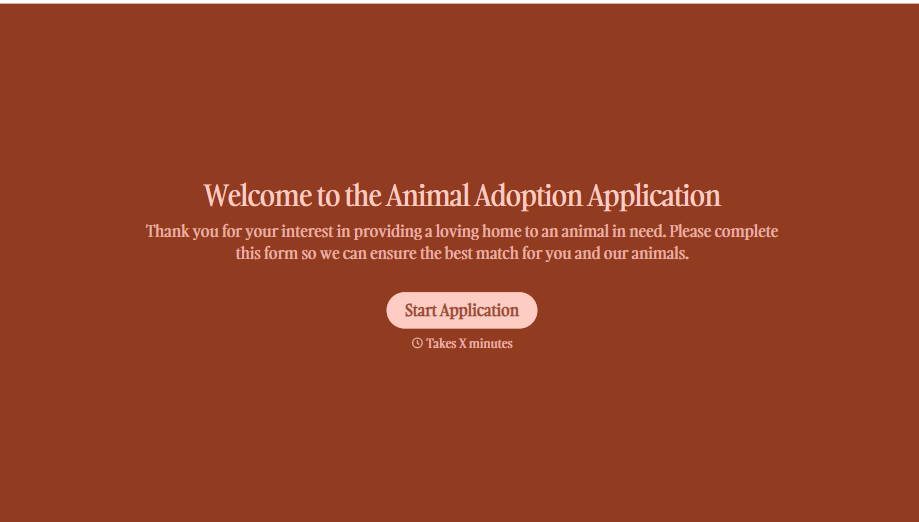
Animal Adoption Application Form
A paper application filled out at the counter while a dog's watching through the window isn't enough information to place an animal in a home that'll actually work. Collect household information, pet experience, and references before adoption day, so your staff aren't approving a placement on a rushed form.
View template
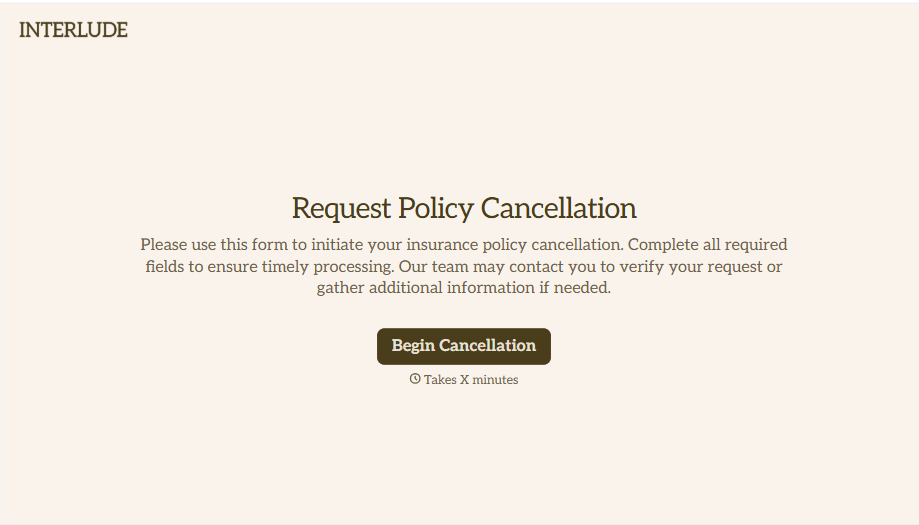
Policy Cancellation Form
A cancellation requested over the phone doesn't leave a clear record of exactly what date the policyholder actually asked for, and that date matters more than it sounds like it should. Collect what your agency actually needs, policy details, identity verification, and the requested effective date, before coverage actually ends.
View template
With Typeform, you can customize everything
Change text, colors, and even logos to match the look and feel of your brand. Then embed forms smoothly onto web and email.
Make forms feel effortless to fill out. Pace questions, call people by their name, and adapt the flow based on the data they share.
Stay efficient by connecting forms to your workflow. Typeform integrates with 300+ tools including Slack, Zapier, and HubSpot.