Daycare Observation Form
Document every developmental observation in the moment, so educators build a clear picture of each child's growth over time.



Daycare educators who rely on paper notes often forget observation details about the children in their care before they can record them properly. A developmental detail is most useful when it's recorded immediately, not reconstructed from memory later. Typeform's daycare observation form gives educators a structured, accessible way to document every developmental observation as it happens.
The form captures educator and child details, observation date, developmental area, a description of what was observed, and any recommended actions. Educators complete one section at a time, so every developmental observation is documented clearly before the record is saved. Conditional logic adapts the observation fields based on the child's age group and the developmental area being assessed. A language development observation for an infant looks different from a social or motor skills observation for a toddler.
Customize it with your daycare name, child roster, developmental domains, and any observation frameworks your team uses. Share it with teaching staff and assistants as a digital alternative to paper observation notebooks. Every observation routes to the lead educator via Zapier, so developmental records stay current without end-of-day entry. Consistent records give parents confidence their child's growth is monitored, and give your team the evidence to respond when a developmental concern needs attention.
A daycare observation form helps educators document developmental observations about individual children in a structured, consistent way. It captures the child's name, age group, developmental area, a description of the observation, and any recommended follow-up. Use it so parent conversations and referral decisions rest on a documented developmental record, not a recalled impression.
Developmental observations are most useful when they're recorded immediately, not assembled from memory at the end of the day. A delayed observation loses context, becomes less specific, and may omit details that a specialist or parent needs. Structured forms create a consistent record across every educator, so developmental tracking doesn't depend on any one person's notes. Use it in infant rooms, toddler rooms, preschool classrooms, and any early childhood setting that tracks developmental milestones.
A complete daycare observation record covers:
- Child's name, age, and room or group
- Date, time, and location of the observation
- Developmental area (language, motor skills, social, emotional, cognitive, self-care)
- Description of what the educator observed (specific behaviors, interactions, or responses)
- Recommended follow-up action (share with parents, refer to specialist, continue monitoring)
Developmental observation records are part of a child's personal file and must comply with applicable privacy legislation. Restrict access to authorized educators and supervisors, and store submitted records securely rather than in a shared folder. If you share observations with external specialists or support services, confirm your sharing practices comply with local privacy requirements.
Use Zapier to route each observation to the lead educator or key worker based on the child and room selected. If the observation flags a developmental concern, routing notifies a coordinator or flags the record for specialist review. Automated routing ensures observations reach the right person immediately, so follow-up happens while the detail is still fresh.
Get inspired by relevant templates and categories
3200+ Templates, 300+ Integrations
Work From Home Request Form
A Slack message asking to work from home on Thursday isn't a request anyone can track, especially once the same employee has asked five different ways over a month. Collect the request type, dates or schedule, and manager approval in one place, so HR isn't reconstructing who's working where from a scattered inbox.
View template
Return of Property Form
A property checklist stapled to an exit interview packet isn't a record anyone can rely on when a laptop turns up missing three weeks later. Collect itemized equipment details, condition at return, and a signed acknowledgment before an employee's last day, so IT isn't chasing down a laptop that already walked out the door.
View template
Early Retirement Form
A retirement mentioned to a manager in conversation doesn't give HR anything to actually process, and if there's an incentive deadline attached, the date that conversation happened can matter more than anyone realized at the time. Collect what your HR team actually needs, employee information, requested date, and benefit elections, before a window closes.
View template
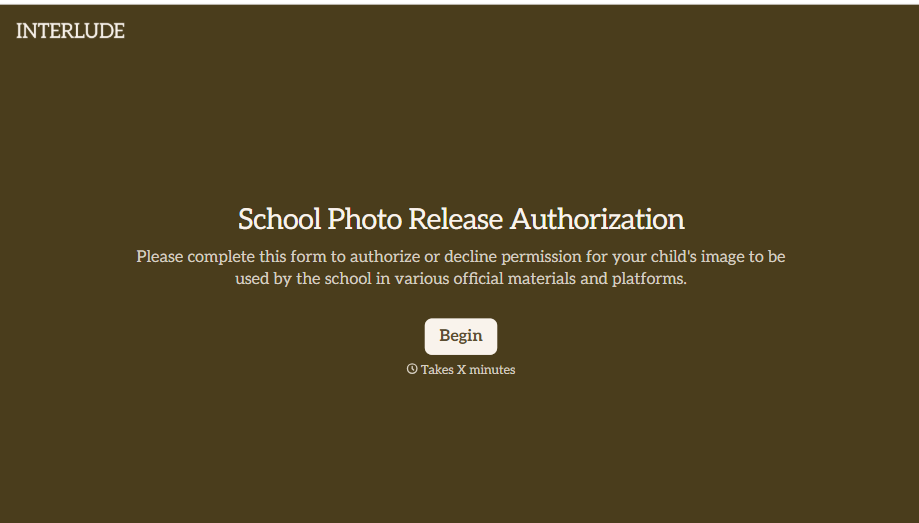
School Photo Release Form
A photo consent checkbox buried on page 12 of an enrollment packet doesn't tell a teacher who's actually opted out before they post a class photo. Collect what your school actually needs, guardian consent, and exactly where a photo can be used, before the camera comes out.
View template
With Typeform, you can customize everything
Change text, colors, and even logos to match the look and feel of your brand. Then embed forms smoothly onto web and email.
Make forms feel effortless to fill out. Pace questions, call people by their name, and adapt the flow based on the data they share.
Stay efficient by connecting forms to your workflow. Typeform integrates with 300+ tools including Slack, Zapier, and HubSpot.