Types of market research: the 8 that matter
There are eight types of marketing research you can try to stay ahead of the competition. Learn more about marketing research methods and how to use them.
Key Takeaways
- Know your "why" before picking a method: Surveys and A/B tests tell you what's happening at scale; interviews and focus groups tell you why it's happening.
- Measure behavior, not just opinions: Usability testing shows what people actually do, often revealing a gap between what they say and their actual behavior.
- Match the method to your needs: Your question, timeline, and budget determine the right approach, not just the method you’re used to defaulting to.
- Combine methods for the strongest insights: Pairing qualitative research (interviews) with quantitative research (surveys, testing) gives you both the "how many" and the "why."
Market research doesn't have to be formal or expensive. At its core, it's collecting information about your customers, competitors, and market, then using that information to make better decisions.
The challenge is choosing which method of market research fits your scenario. Need to understand customer sentiment? Use one method. Want to test a new product concept? A different approach may work better. Want to stay ahead of competitors? That’s yet another path.
This guide walks you through eight distinct types of market research, when to use each one, and how to get started. Whether you're launching a product, refining your positioning, or trying to understand your audience better, there’s a method that works for your goals.
1. Surveys and questionnaires
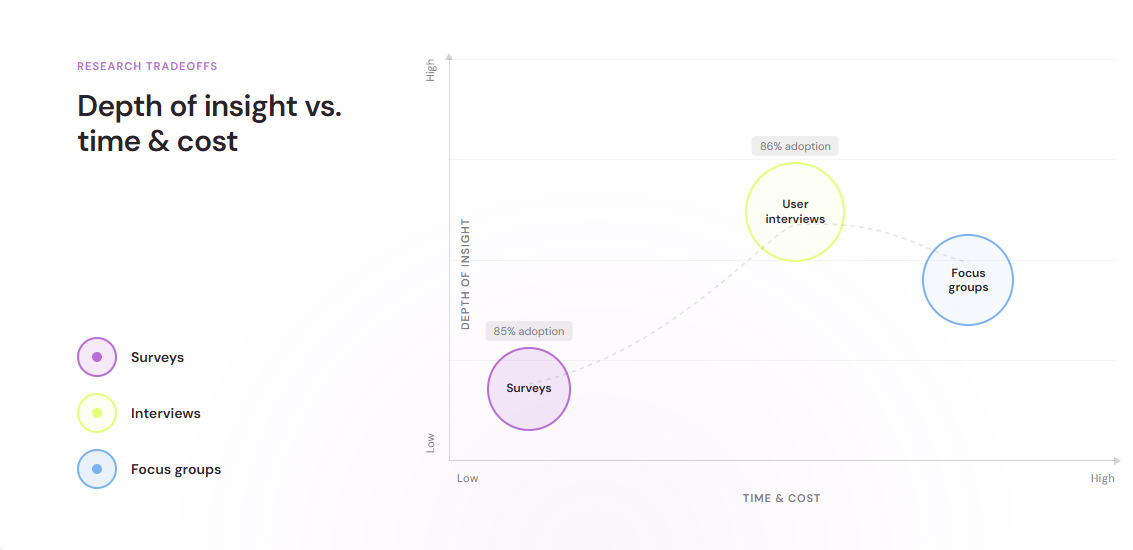
Surveys are a foundational market research method. They’re easy: you write questions, people answer them, and you analyze the results. Online surveys rank as the most used quantitative method among market research professionals, with 85% using them regularly.
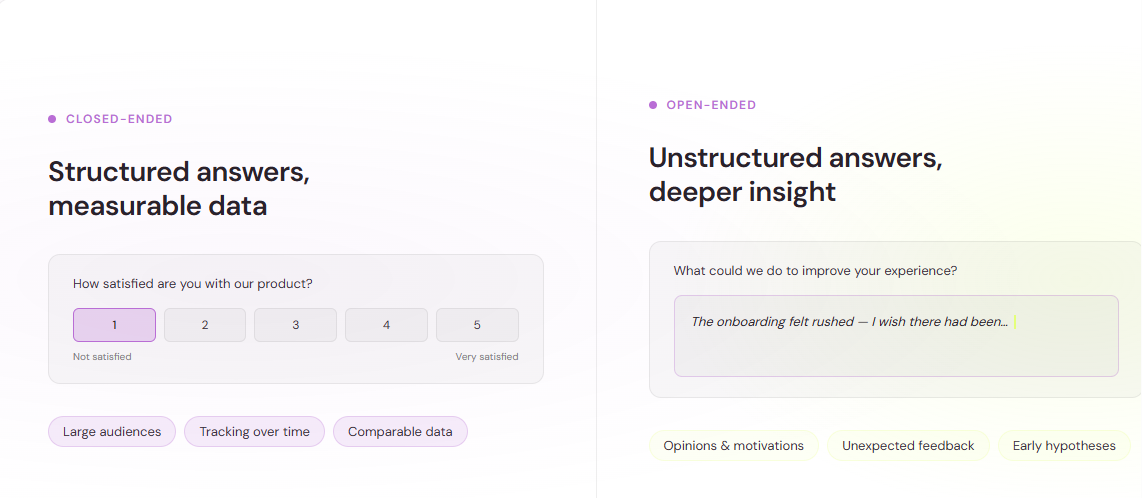
Surveys work when you need feedback from many people quickly. They're especially useful for measuring attitudes, preferences, and satisfaction across a large audience. You can ask closed questions ("On a scale of one to five, how satisfied are you?") for clean data, or open-ended questions ("What could we improve?") for deeper insights.
Surveys can introduce bias. Acquiescence bias—the tendency to agree with statements—and social desirability bias—overreporting good behavior—are common pitfalls. Keep questions neutral and give respondents permission to be honest.
When to use surveys:
- Measuring satisfaction or sentiment across a large audience
- Gathering feedback on multiple topics at once
- Validating ideas or concepts with a broad group
- Tracking changes over time
2. User interviews and qualitative research
If surveys give you the "what," interviews give you the "why." In a user interview, you talk directly with a customer or prospect to understand their needs, pain points, and motivations in depth.
User interviews are conversational. You might start with a prepared question, but follow where the conversation leads. Listen more than you talk. The goal is understanding the person's perspective, not validating your assumptions.
User interviews rank among the most popular UX research methods. They uncover the "why" behind behavior and reveal unexpected insights surveys might miss. Interviews take time, but when you need deep understanding, especially early in product development, they often pay for themselves many times over.
When to use interviews:
- Exploring customer pain points and motivations
- Testing a new product concept or feature idea
- Understanding how customers currently solve a problem
- Diving into unexpected survey results
3. Focus groups
A focus group is an interview with a small group—usually 6 to 10 people—rather than one person. A moderator guides the conversation, and group interaction often generates ideas that one-on-one interviews might miss.
The group dynamic creates a controlled brainstorm. One person's comment sparks another's, generating richer discussion. Focus groups work well for exploring reactions to messaging, testing concepts visually, or understanding how people talk about a problem.
The downside: louder voices can dominate, and groupthink can suppress dissenting opinions. They also require skillful moderation to generate actionable insights.
When to use focus groups:
- Testing brand messaging or positioning
- Exploring reactions to a new product concept or design
- Understanding how people talk about a problem
- Generating ideas on a broad topic
4. Usability testing
Usability testing puts a real product—a website, app, or prototype—in front of real users and watches what happens. Participants try to complete a task while you observe and note where they get stuck, confused, or frustrated.
Usability testing measures behavior, not just opinion. Someone might say your website is easy to navigate, but testing might show they spent five minutes looking for the checkout button. The test reveals the gap between what people think and what they actually do.
Every $1 invested in UX returns $100, yet only 55% of companies conduct UX testing. Meanwhile, 63% of mobile users quit sessions due to avoidable usability issues—problems that testing would catch.
Usability testing works best with prototypes or live products. Sessions are usually brief (15–30 minutes) with 5–10 people per round, letting you iterate quickly.
When to use usability testing:
- Testing a website, app, or feature before launch
- Identifying where users get stuck or drop off
- Comparing two design approaches
- Improving an existing product's user experience
5. A/B testing and multivariate testing
A/B testing (also called split testing) compares two versions of something—a headline, button color, landing page layout, email subject line—and measures which performs better. Multivariate testing compares multiple elements at once.
A/B testing removes opinion from the equation. You're not asking what people prefer; you're measuring which one they actually choose. If version A gets a five percent click-through rate and version B gets seven percent, version B wins.
A/B testing requires traffic and a clear metric to measure (clicks, conversions, time on page, bounce rate). It's most useful for refining an existing product or marketing channel, not exploring new ideas.
When to use A/B testing:
- Improving conversion rates on websites or landing pages
- Testing different email subject lines or messaging
- Refining product features or user flows
- Making decisions backed by actual behavior data
6. Competitive analysis and market research
Competitive analysis is research about your competitors and the broader market landscape. It includes studying competitor websites, pricing, product features, customer reviews, marketing tactics, and positioning. You're looking for market gaps, threats, and differentiation opportunities.
Market research at this level also includes secondary research, including analyzing published reports, industry trends, and public data. The global market research industry generated approximately $140 billion in revenue in 2024, reflecting how seriously organizations take competitive intelligence.
Competitive analysis doesn't require surveying anyone or running experiments. You can gain insights by reading competitor reviews, following their marketing, and reading industry reports.
When to use competitive analysis:
- Understanding your competitive landscape
- Identifying market gaps or underserved customer segments
- Benchmarking your positioning, pricing, or features
- Spotting industry trends and shifts
7. Quizzes and interactive tools
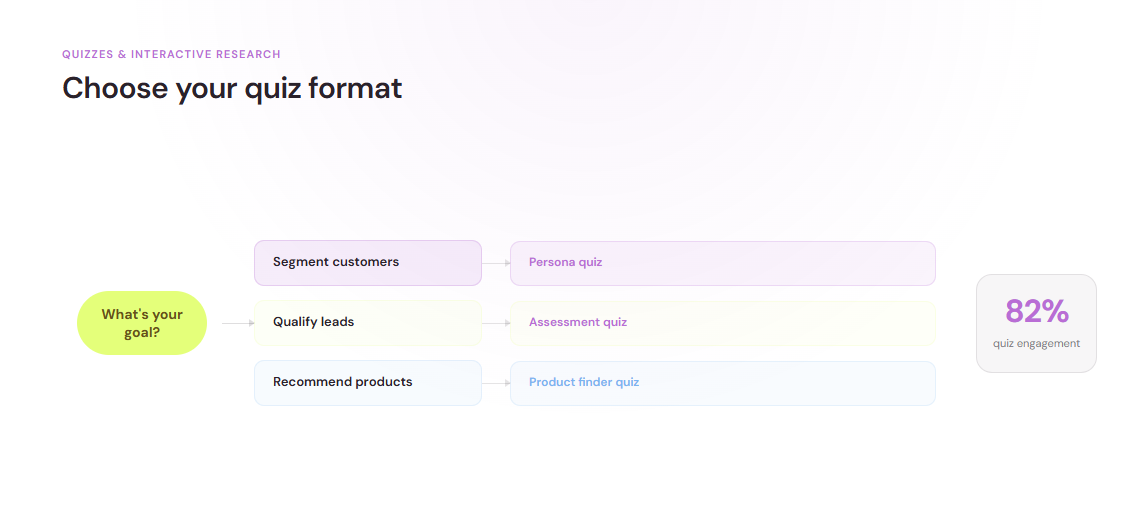
Quizzes engage people and gather data simultaneously. They're fun to take, which means high engagement. A quiz might ask people to rate their skill level, identify pain points, or classify themselves into a segment, with respondents receiving immediate personalized results.
That engagement pays off in results. People spend over three times longer engaging with quizzes than with static articles, and completion rates run 80-85%, so once someone starts, they tend to finish and share their details. Quizzes also convert that engagement into leads, with capture rates around 30%.
Quizzes work best when the result genuinely matters to the participant. A "Which product is right for you?" quiz works because people want the answer.
When to use quizzes:
- Engaging your audience while gathering data
- Qualifying leads based on fit or intent
- Categorizing customers into segments
- Providing immediate value in exchange for data
8. Panels and longitudinal studies
Research panels are groups of pre-recruited people who agree to answer surveys or participate in studies over time. Instead of finding new respondents for each survey, you have a standing group ready to go.
Panels are especially useful for tracking changes over time. Run the same survey monthly, quarterly, or yearly, and you'll see how attitudes, preferences, or satisfaction shift. You'll spot trends early and reach specific audiences like software developers or small-business owners more efficiently.
The trade-off: panel members see many surveys, so response quality can decline if overused. They're also not ideal for exploring genuinely new ideas. That’s because panels surveyed often might give automatic answers rather than fresh thinking.
When to use panels:
- Tracking sentiment or satisfaction over time
- Running regular surveys with a consistent audience
- Reaching niche audiences efficiently
- Building a customer advisory group or research community
Choosing the right method
The best market research strategy often combines multiple methods. You might start with user interviews to understand the problem, run a survey to measure how widespread it is, test your solution with usability testing, and validate the final version with A/B testing.
The method you choose depends on three things: your question, your timeline, and your budget.
Your question determines the method. If you need to know "how many people care about this?" use a survey. If you need "why do people care?" use interviews. If you need "will this work?" use testing.
Your timeline matters too. Surveys and A/B tests run parallel with product development. Interviews take longer to schedule. Competitive analysis can happen quickly by reading reviews and reports.
Your budget shapes what's realistic. Online surveys are low-cost. User interviews cost more. Panels have ongoing costs but save money if you run frequent studies.
Nearly 50% of researchers worldwide now use AI regularly in their market research activities, making it easier to analyze survey data, interviews, and other methods faster than ever.
Getting started
Start small. You don't need a massive research program to make better decisions. A few user interviews, a short survey, or a competitive analysis can shift your perspective and validate your assumptions.
Pick one method that matches your most urgent question. Run it. Learn. Decide what to research next.
Let the insights drive your next move.